

Mavis Muller - The Burning Basket
/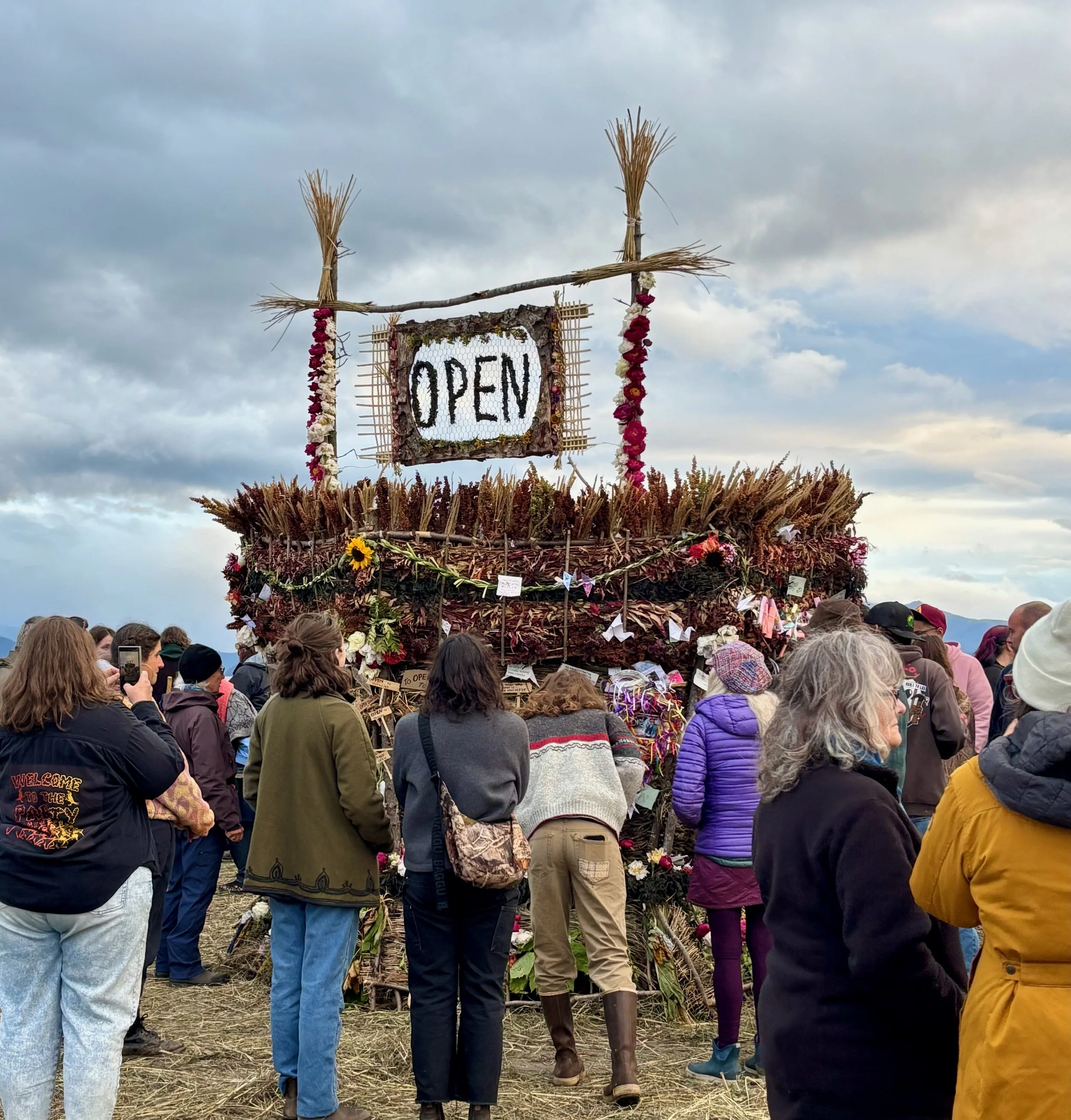
2025 Homer Burning Basket by Mavis Muller
The poet Robert Frost famously considered whether an ending might arrive best by fire or by ice. Weaver Mavis Muller is an artist who knows from the beginning how her large, community projects will end; and her annual “Burning Basket” event in Homer, Alaska leaves no doubt that spark and heat and flame signal the culmination of a piece.
Homer is a place known more for ice than for fire: the beach on the Homer Spit where Mavis builds her towering basket is surrounded by icy peaks, frozen volcanoes, and the Harding Glacial Field across a cold Kachemak Bay. Yet Mavis knows that fire draws humans in. “Fire is one of the most elemental forces we know,” she says. “Fire embodies both creation and destruction, death and rebirth, and the power to consume and renew.” It is in this duality, then, that Mavis creates, then destroys, a singular, beautiful container that holds whatever Homer brings to it; and then, together, they release all of it in a magnificent conflagration.
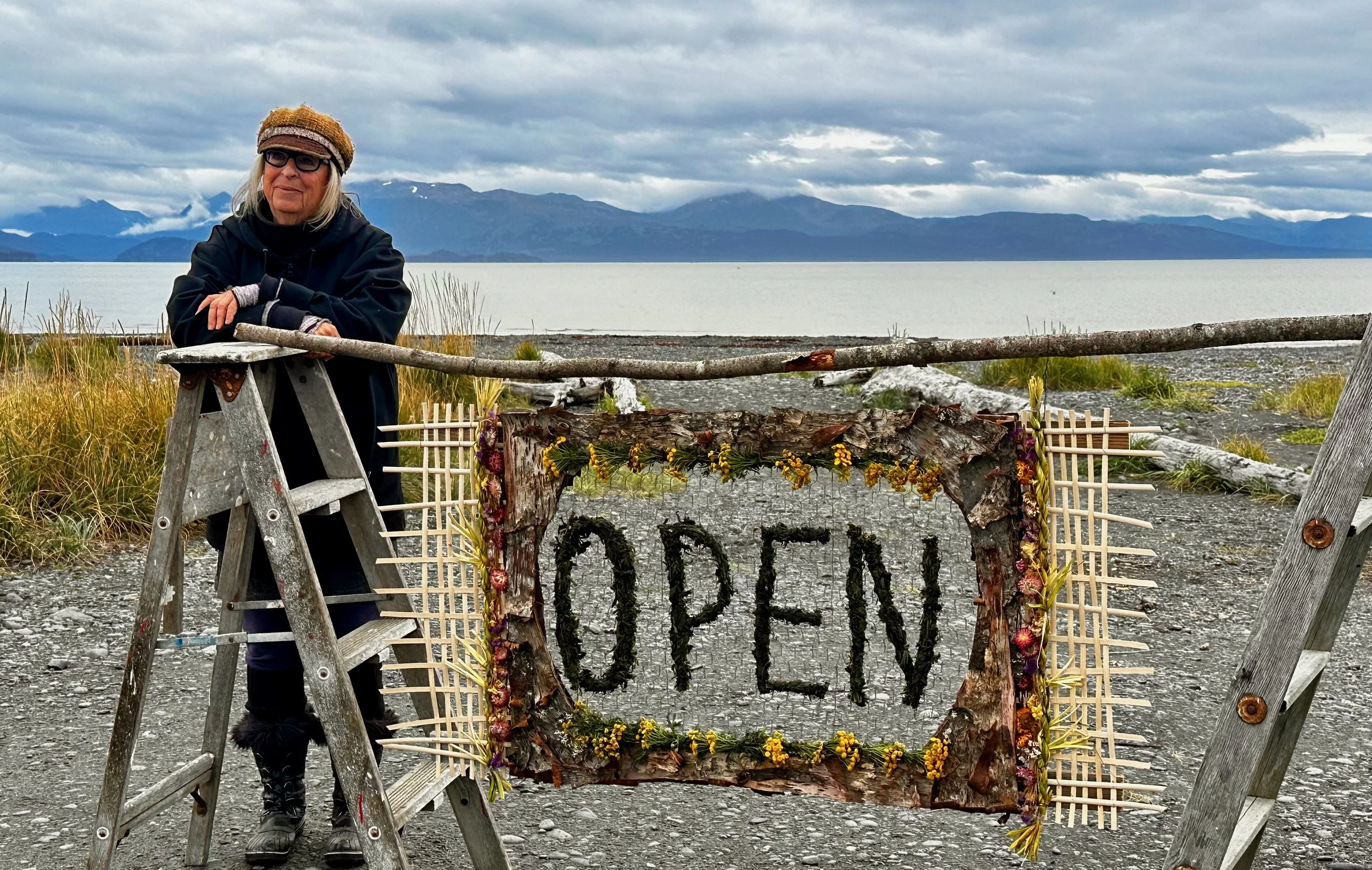
For 22 years, each September, Mavis has created a large basket by the sea in Homer that is built by community over a week – woven with local materials, adorned with flowers and notes, consecrated by music and dance - and then is burned in community for all to see. She calls it the “Burning Basket” and each year the basket offers a word – always a verb – that floats above it to spirit its builders, and offer guidance for creation and, perhaps, absolution. In 2025, Mavis’ word for the Burning Basket was “Open.”
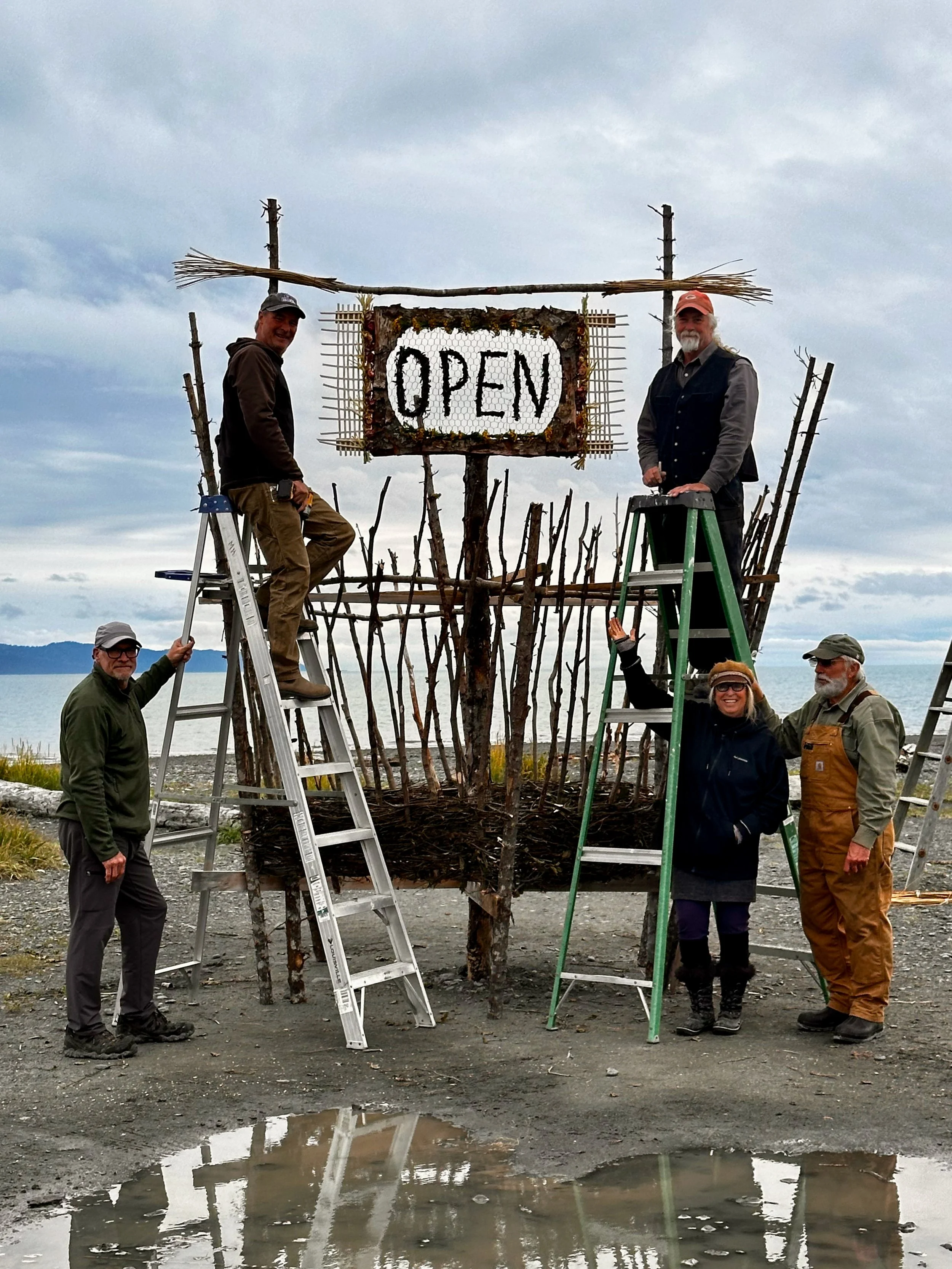
Mavis and Volunteers attaching “OPEN” sign for 2025 Burning Basket in Homer, Alaska
Weaving is an ancient art form, and Mavis has long been a practitioner. “I have always been crafty with my hands. I learned that at a young age from my mother,” she admits. “I grew up in a Ponderosa Pine forest. I taught myself to weave with pine needles.” Mavis adds that before her, her Ukrainian grandmother wove cattails, an art form she learned from her ancestors. When Mavis moved to Alaska, she adapted her art to her surroundings. “I had to improvise with other materials,” she says. “For over 40 years, I have been making baskets. As an Anglo, I am not trying to copy traditional Indigenous baskets. These are original designs.” She continues: “Many footprints follow the same path, but they do not always end up at the same place. I am borrowing ancient techniques, but I am doing my own thing.”
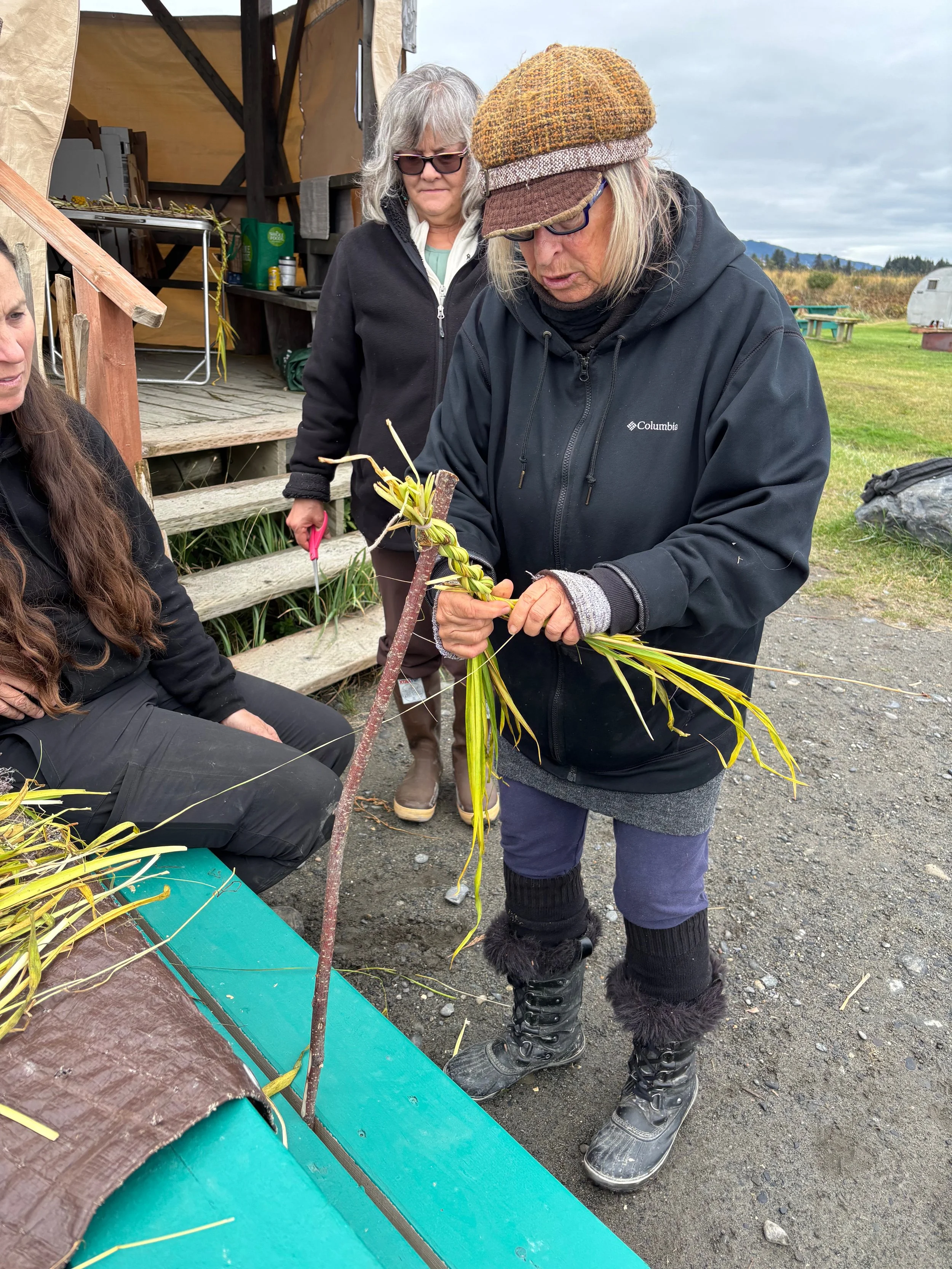
Mavis twisting grasses to weave into Burning Basket
Mavis lights up when she talks about weaving large-scale pieces like Homer’s Burning Basket. As a professional artist, Mavis weaves both small and larger objects. Some of her work is in galleries and private collections; some of it is not. “I have always worked intuitively,” she says. “I have skill at weaving large objects; it requires strategy and engineering.”
To date, Mavis has crafted and offered 42 Burning Baskets to communities around the US and abroad in Mexico, Spain, and Panama; 22 of those baskets have burned on the beach of the Homer Spit. Early Burning Baskets rose up on the Big Island of Hawaii and Maui. In Petaluma, California, Mavis constructed a woven casket out of red willow, eucalyptus bark, and redwood bark. She enlisted volunteers and together they carried the casket in a Day of the Dead procession. “I held a place of prominence in that parade,” she says proudly, “dancers threw petals on it!”
That experience sparked an idea: Mavis could expand her artistic practice and weave caskets for “green burials.” Back in Homer, a good friend, Eva, was interested in just such a burial container. Eva and her family joined Mavis in her Homer studio to weave a casket, even while Eva faced imminent death. “Eva was there for the making,” Mavis says solemnly, but not without joy. “She tied bundles of grass that she would lay on, then got in and ‘tried it on’!” Working with a living person who was planning for death amazed Mavis. “I knew I wanted to be of service in this way,” she offers. And it was, by Mavis’ admission, a “full sensory experience” to weave a casket for her friend and later participate in Eva’s final, collective send-off by the sea. “There was the building,” Mavis recounts, “then the burning, the sizzle of waves coming in on the burning casket and the floating logs. We thought, ‘There she goes!’ and then, with the waves: ‘Here she comes!’”
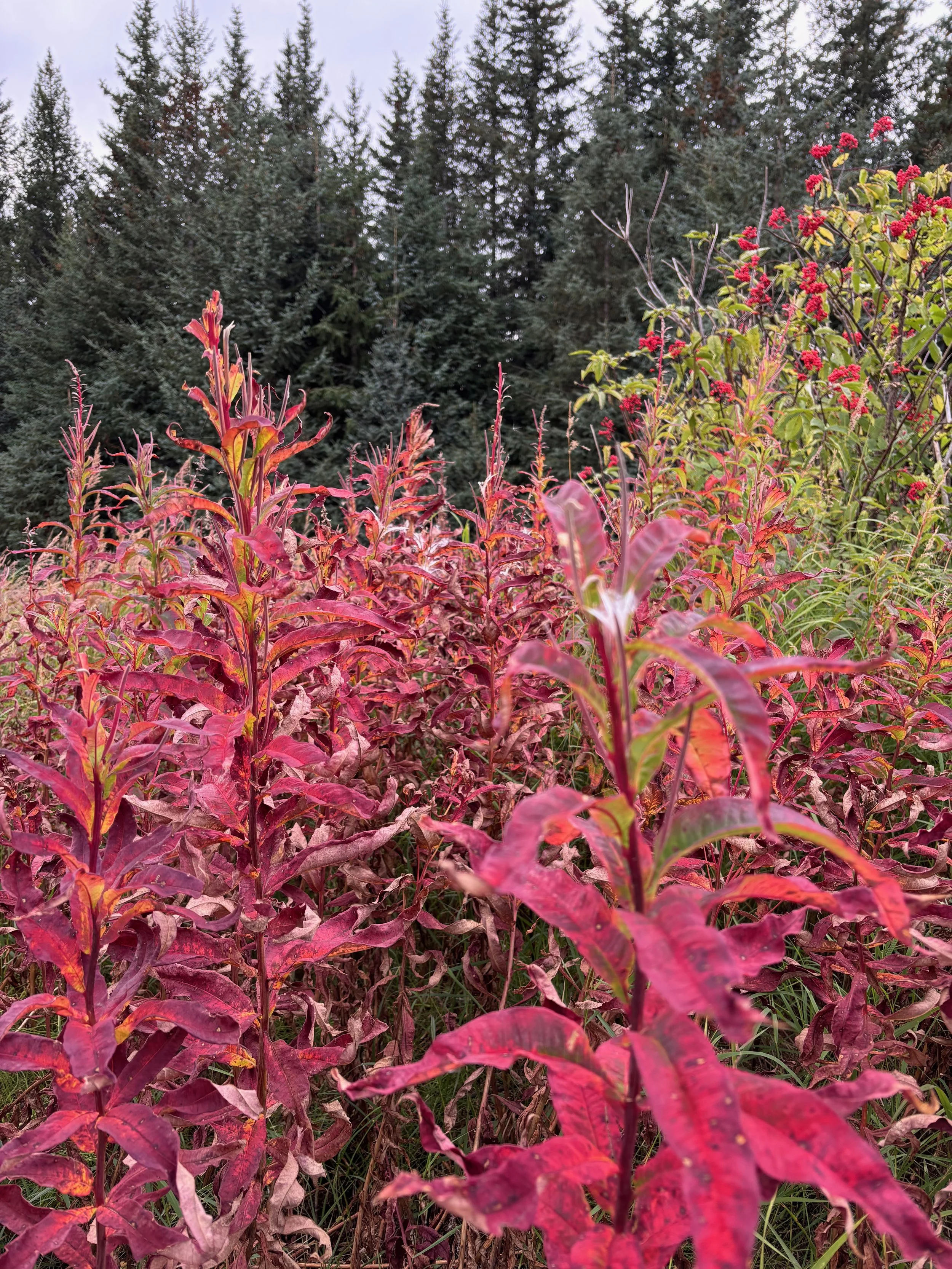
The joy of offering her art for community arises, in part, from the meaning Mavis ascribes to the materials she uses. She is deeply connected to, and inspired by, the local plants with which she works, including alder, nettles, fireweed, wild grass, and spruce:
· The structural element of her Burning Basket in Homer is alder. Common and strong, Mavis says “alder is persistent. It will come back again and again. Alder grows on the banks of salmon spawning streams,” noting the importance of fishing to Homer; and, like humans, “the alder and salmon share marine-derived nutrients”
· “Nettles are self-protection”
· Wild grass: “I look at the roots, firm and rooted. This grounds us in community, in creative expression. I think of sinking our still-wild roots into the ground”
· Fireweed “is the first thing to grow on damaged ground”
· Spruce: “They grow to the light!”
Weaving the Burning Basket is a spiritual practice for Mavis but it is not religious, and perhaps the most important element of the project is the people who join in the construction. “It means so much to me when strangers show up and bring good energy to me,” says Mavis. She spent years working alone in her studio and, eventually, she craved more company: “Our energies reflect, good to good, and so on,” she noticed. “I had become withdrawn into my creative world. Part of what brought me out into the real-world community was that I was needing what musicians do: they jam.” The impetus for the first Burning Basket then was Mavis’ need toward a “group dynamic” of getting “into each other’s head and jamming!”
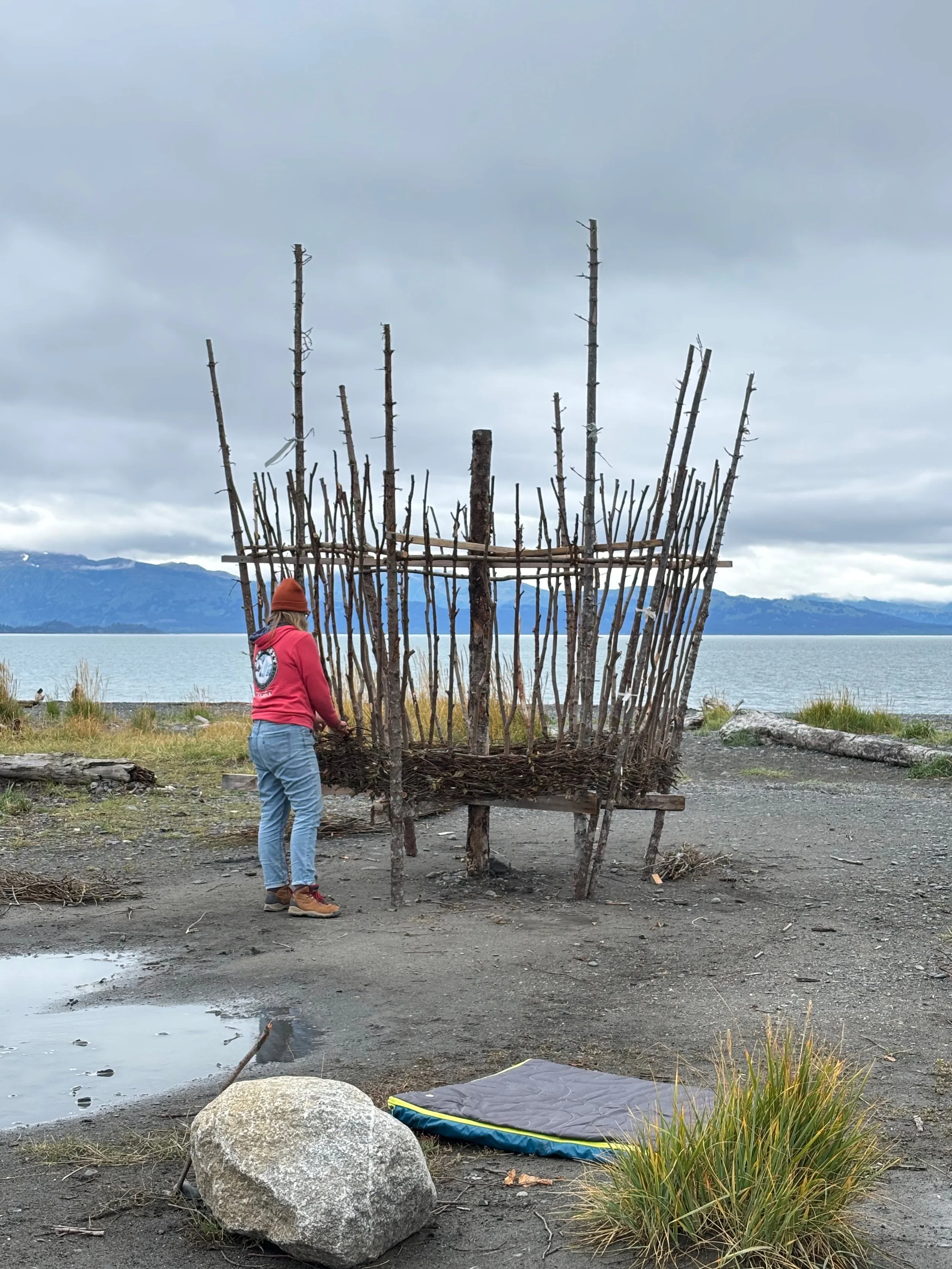
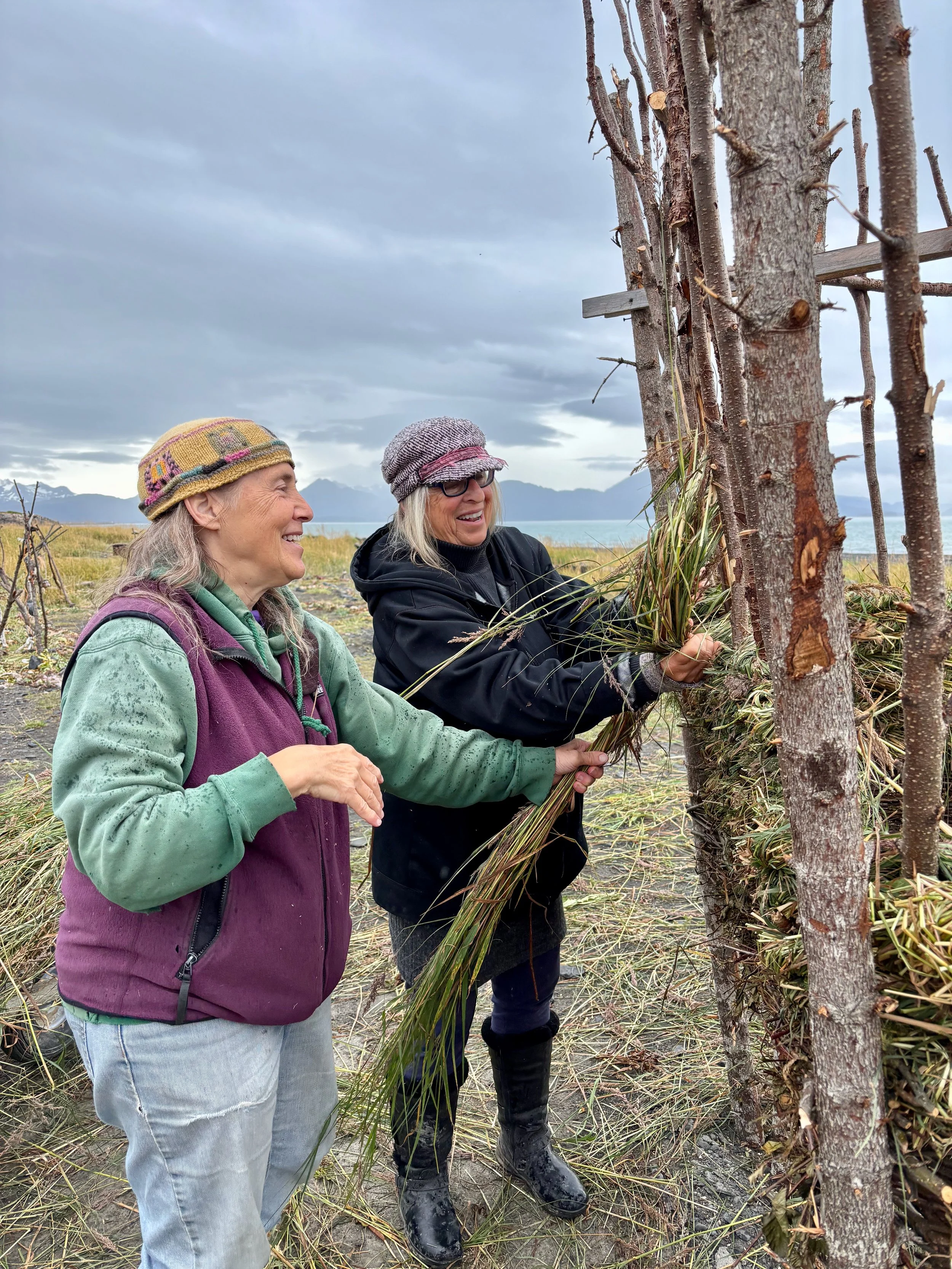
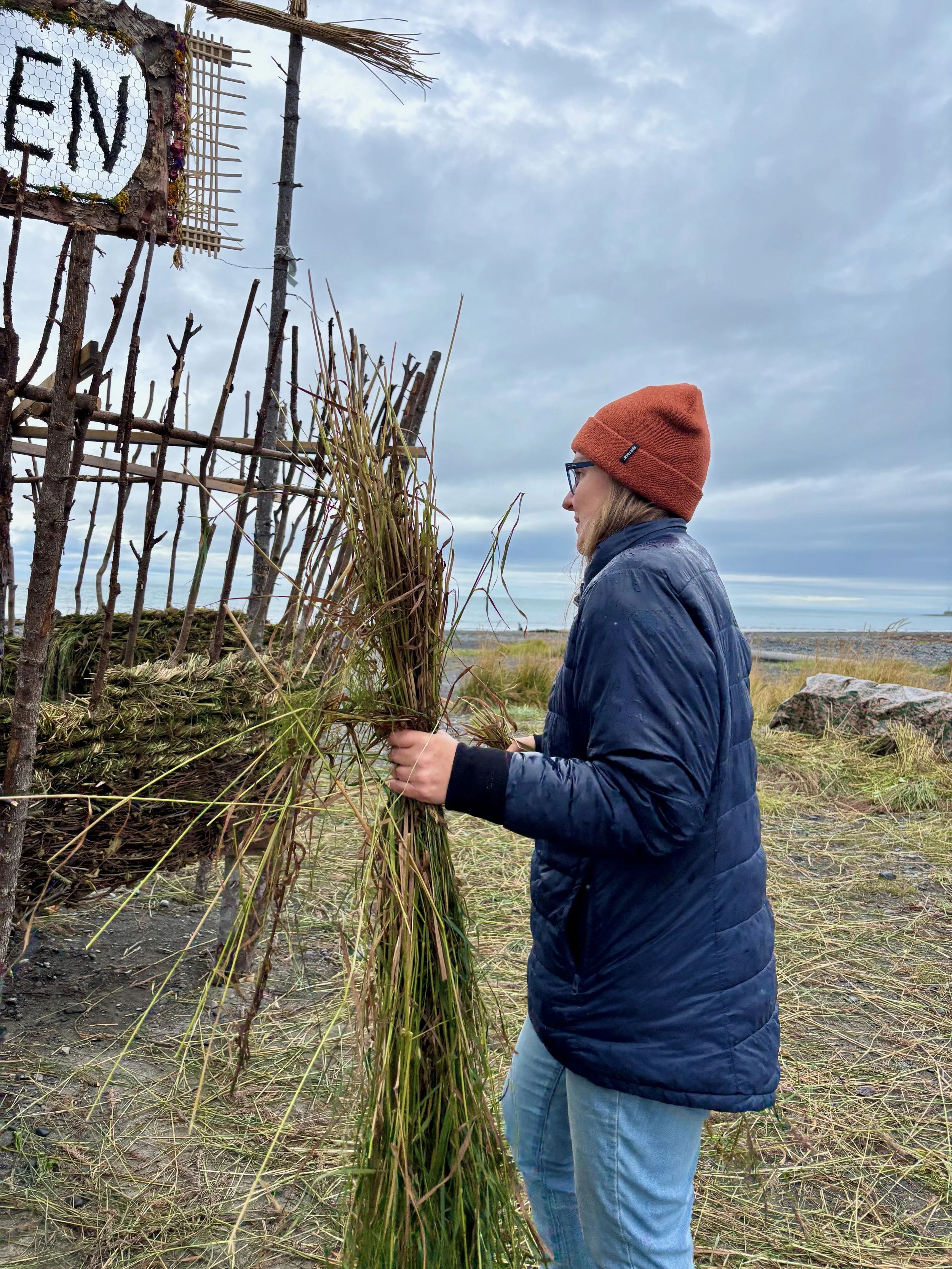
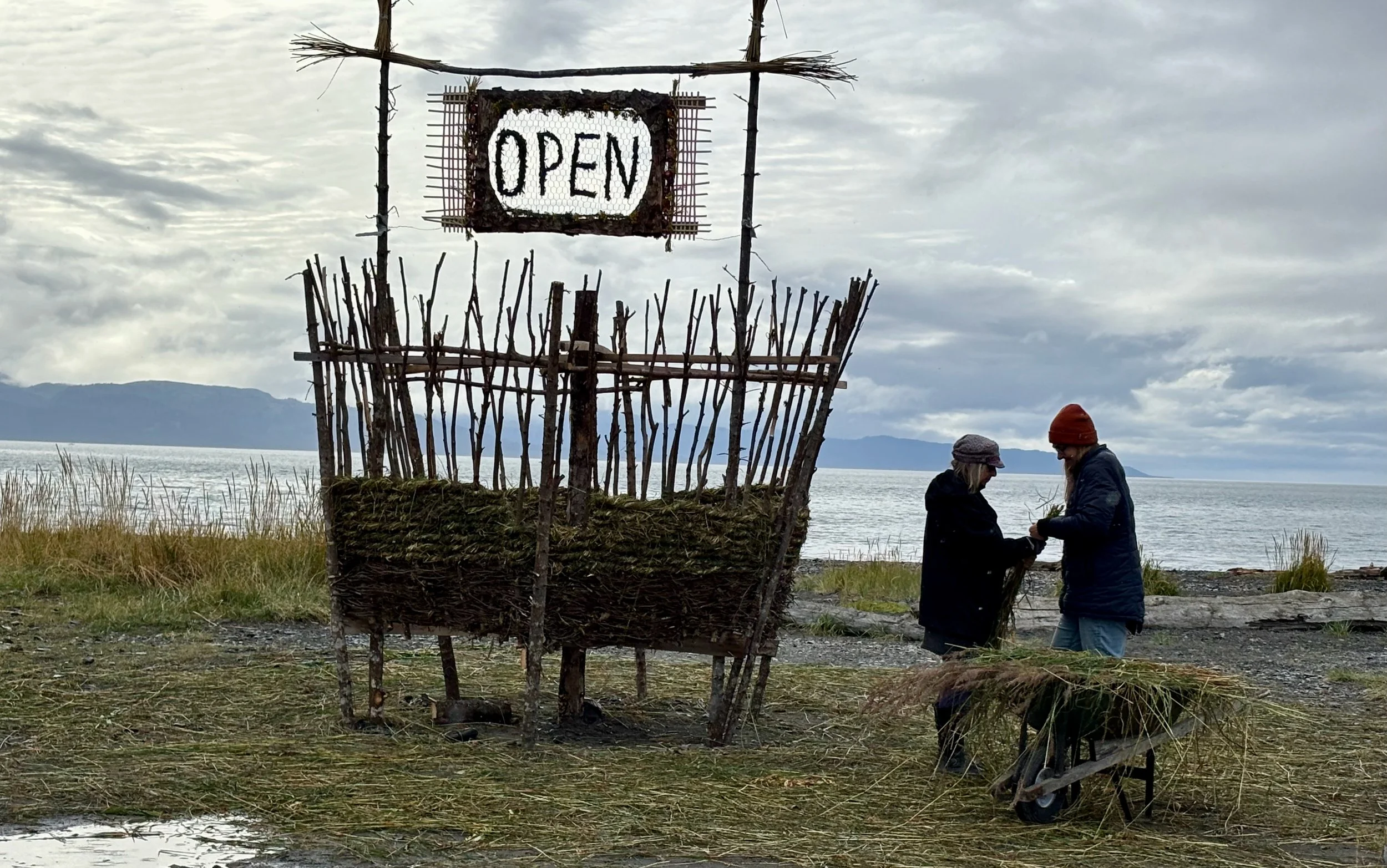
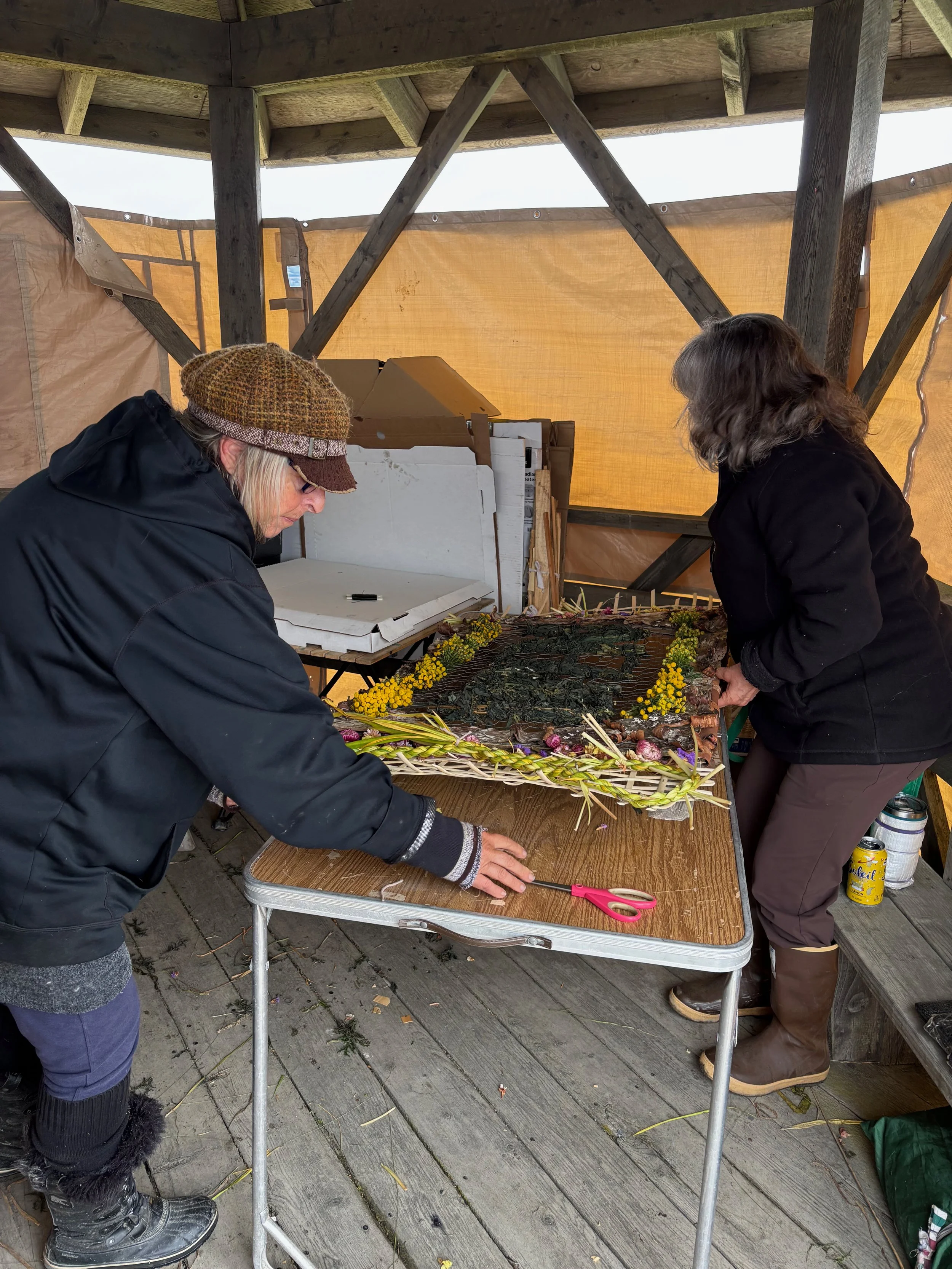
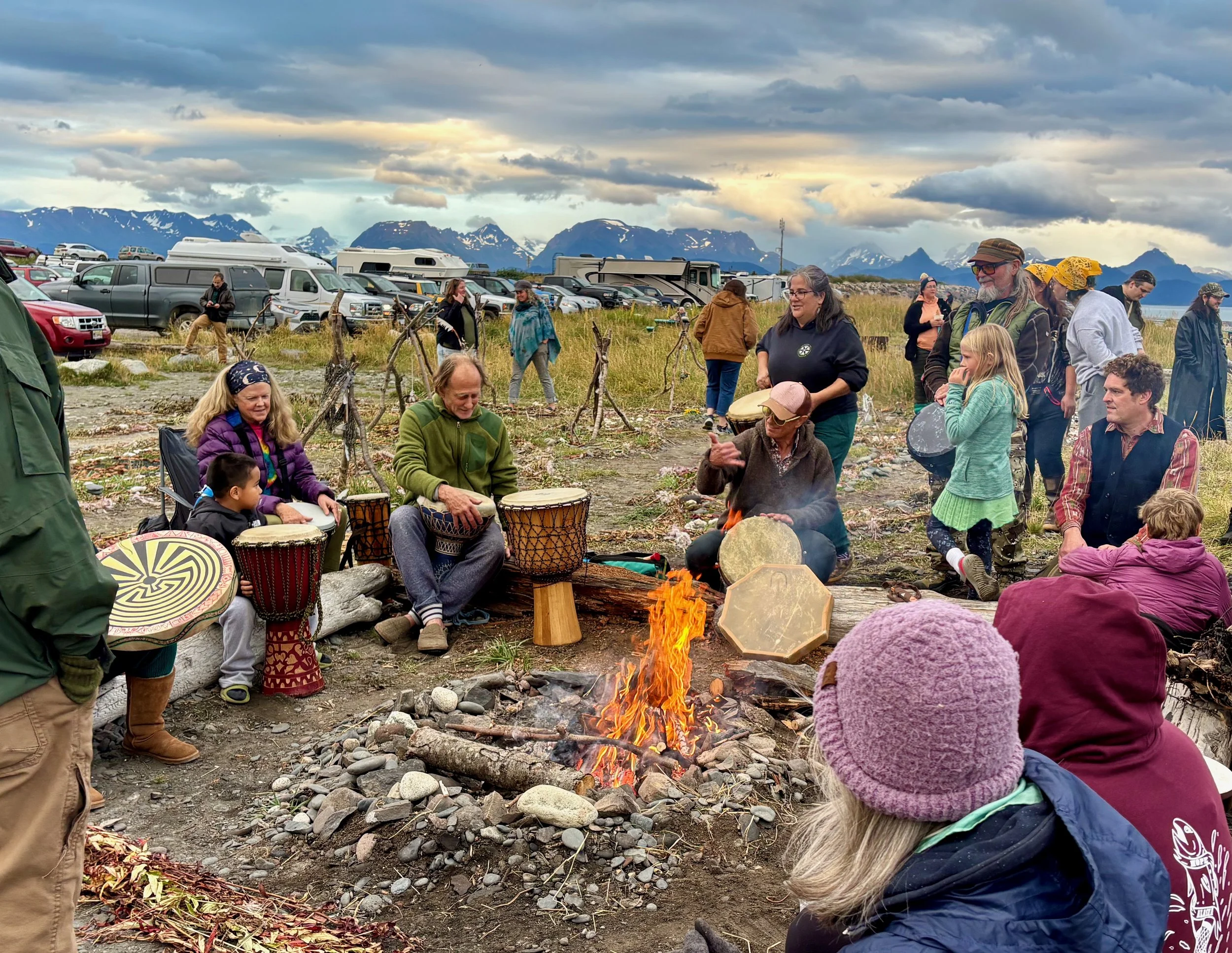
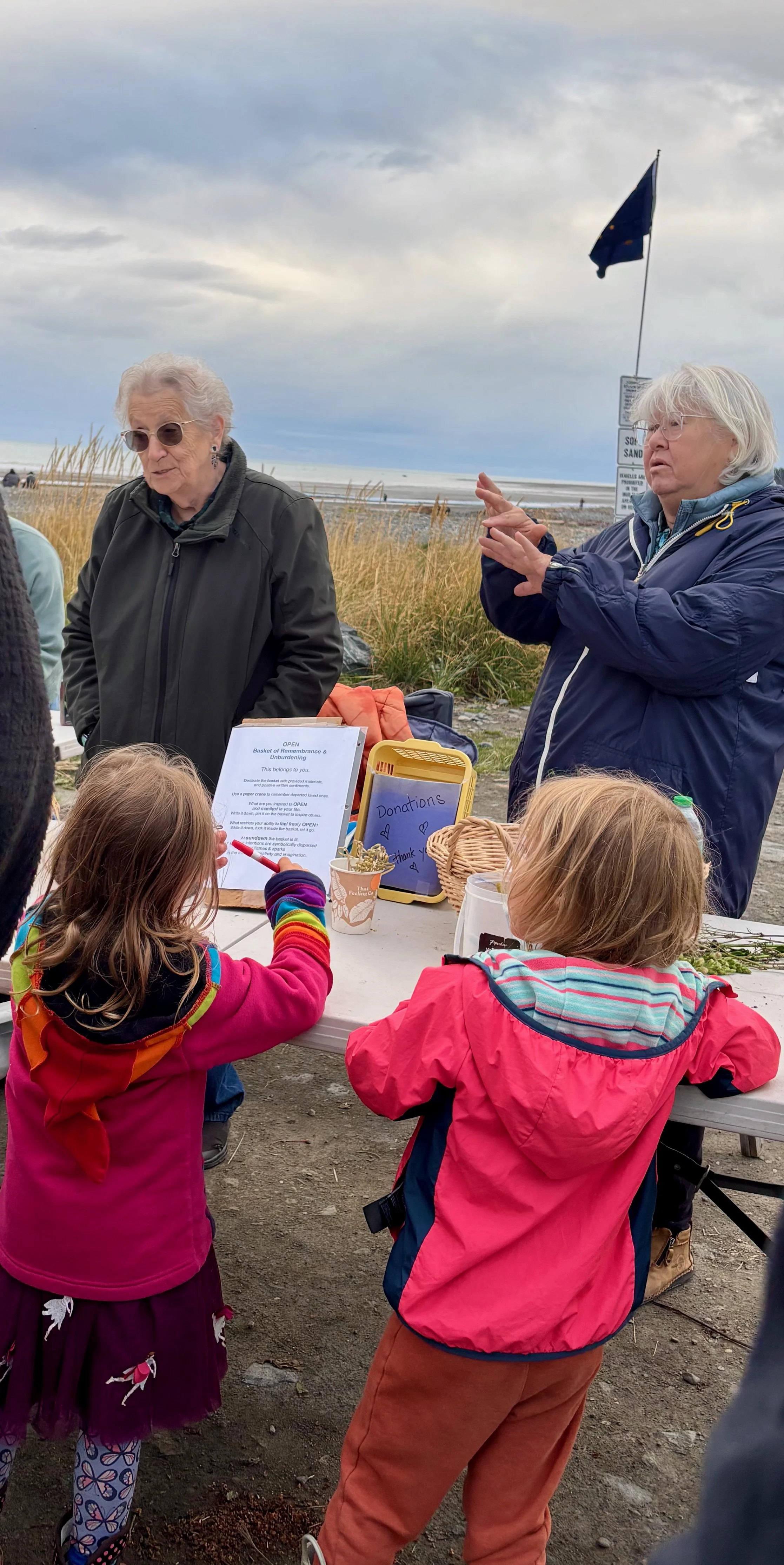
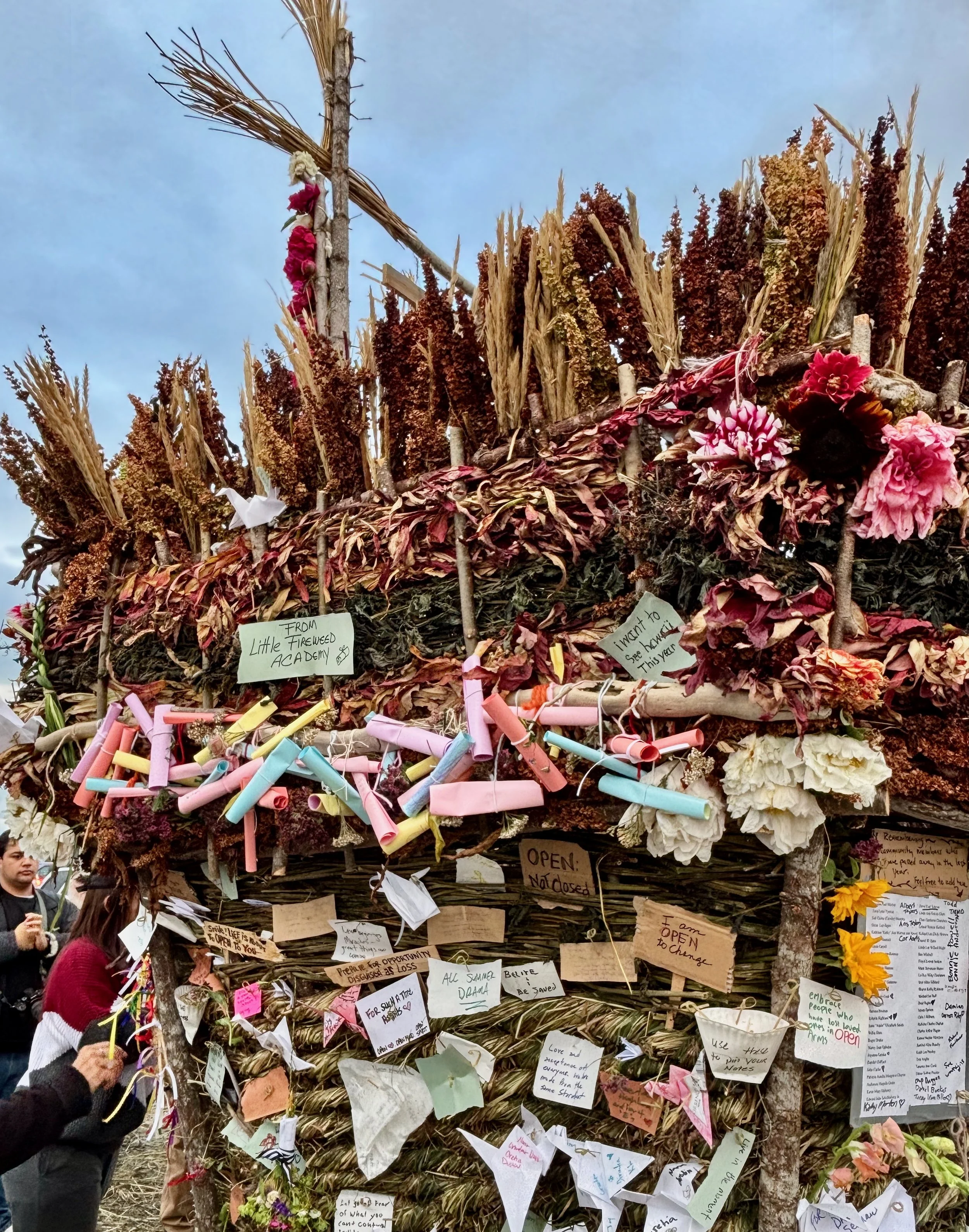
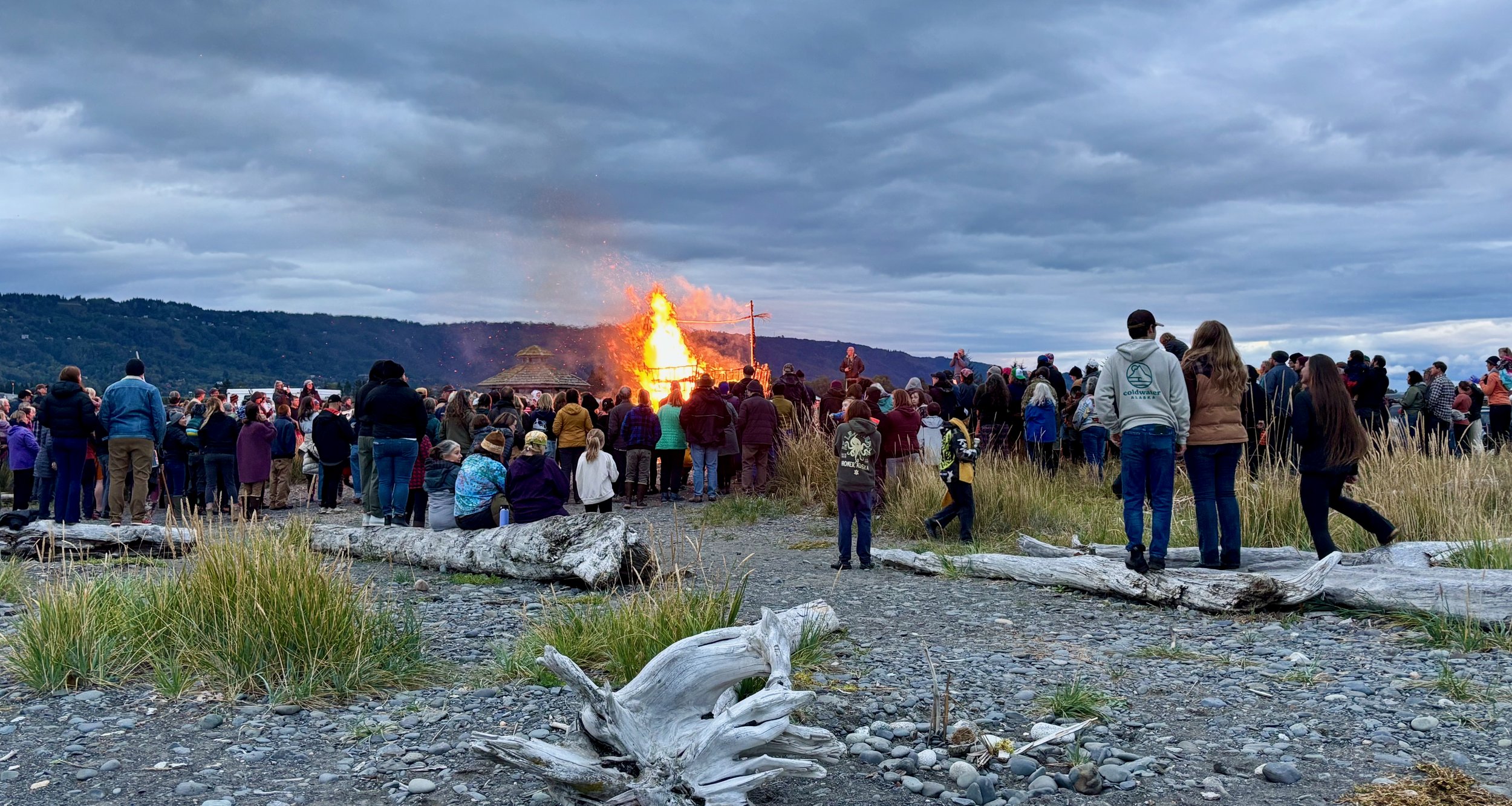
In September 2025, hundreds of Homer residents and visitors joined the creation of the Burning Basket. They gathered materials from the land and beaches around Homer; they participated in the weaving and the decorating; added music and folded origami cranes; and witnessed the burn. For 6 days, volunteers showed up each day at the beach and hand-wove flexible twigs of alder, twists of grass and nettles, and spruce boughs horizontally (the weft), in and out of the more substantial, vertical alder branches (the warp) that Mavis uses to create a twelve-foot-tall structure.
The top of the basket holds a word – the theme of the year’s build and burn. “It’s always a verb,” Mavis says. “I love words! I make a list of potential verbs that would be easy and fun to introduce to people with quotes, idioms, themes. Lyrics of songs. I go down the rabbit hole, imagining the placards, and what others are going to write.” Mavis describes how selecting the word begins the entire process each year: “I have a personal ritual. I choose the theme word and I make the sign that announces the word. That is the day that the basket breathes its first breath. I introduce the basket to the people! It inspires them as to how they will interpret the word. They can see the intention. In the final hour when it is lit, there is no doubt. They don’t say ‘What is this?’ If they have read the collage of words on it, they will be well-informed.”
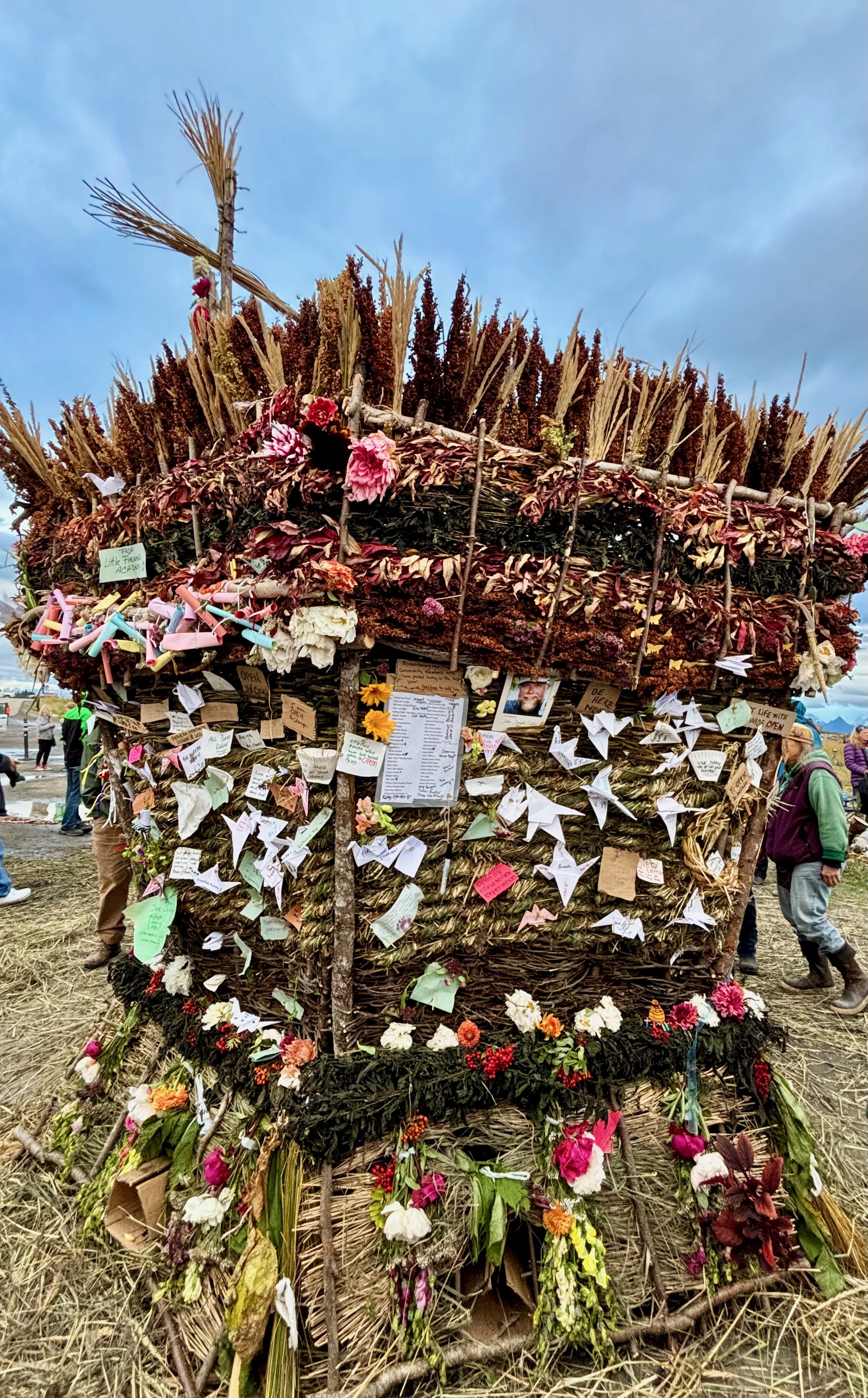
Mavis never knows who will come, or how many. Buckets of fresh-cut peonies and other blooming flowers arrive (all donated) to adorn the basket. There is a resolute team in charge of the fire, the lighting and containment. And there is a clean-up crew for the day after.
On the evening of the event, hundreds of attendees show up and heed the invitation (or not) to write the name of a loved one they‘ve lost, or a prayer, or a bit of a poem or song, or a wish onto colorful bits of paper and the wings of folded cranes to pin to the basket with wooden skewers. Drummers drum in a circle. Children run through the nearby labyrinth created with beach finds of shells and sticks and rocks. Cloth flags encircle the space with words like “Radiate,” “Imagine,” “Shine,” “Expand,” or “Renew” (themes from previous years) to bless the current burn with sentiments from the past.
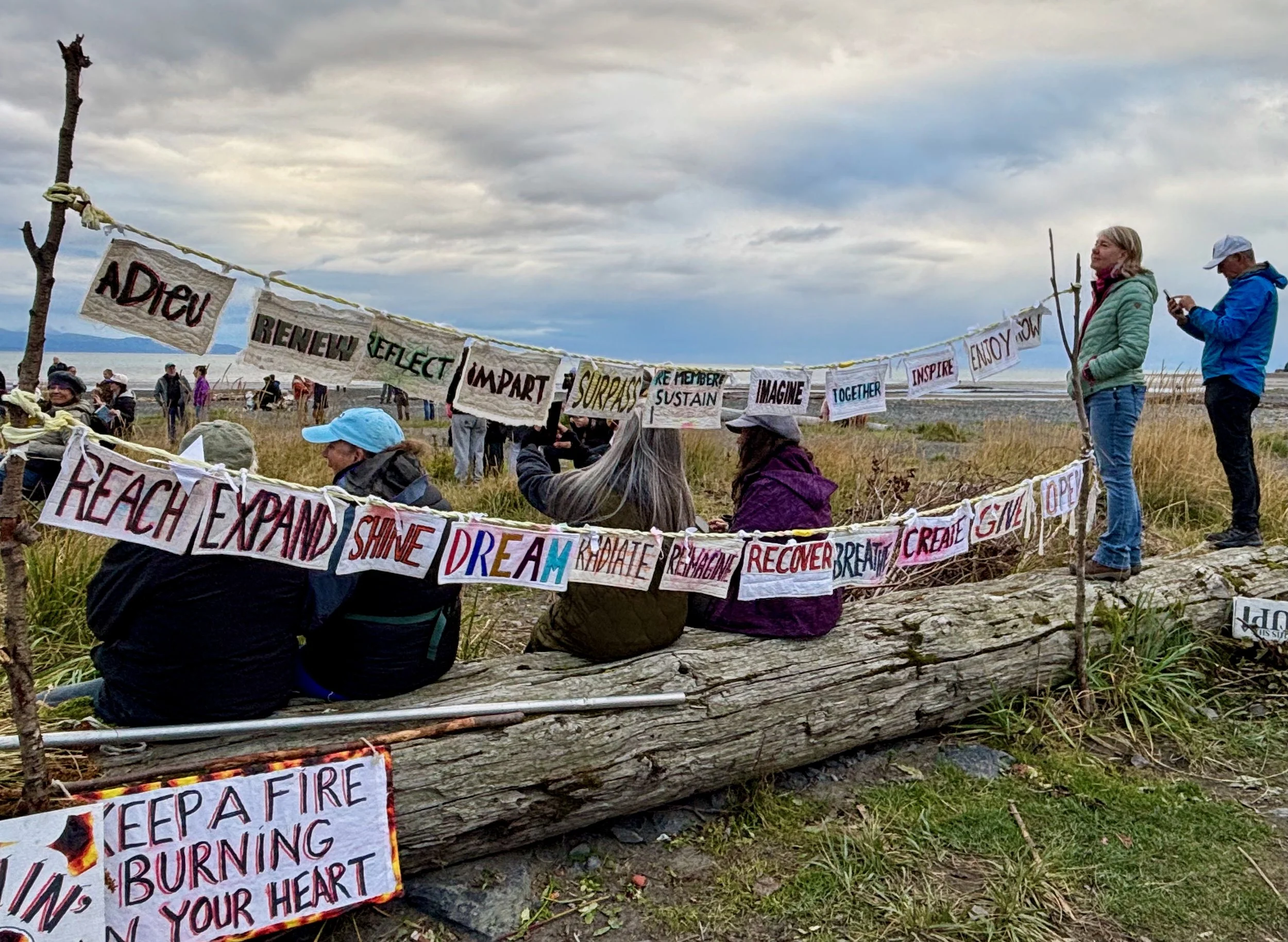
Mavis understands that everyone who helps weave the basket, who adorns it, or who simply watches the burn comes for their own reasons. Some come because they are grieving, or because they are hoping for a change. Others come because their neighbors will be there and it feels festive, or because they want their children to participate in an event that is artistic and inclusive. Some people come just because it’s fun to watch something burn! “I’m not telling people what to do,” Mavis insists. “It is a release. It’s creativity and imagination, with no context of religion or belief system, no logos, no sponsors.” Just people, and woven twigs, and hours of communal handiwork, and paper cranes, and fire. Mavis adds: “I have the gift and talent and my life’s work. As long as my hands work, I will do this work.”
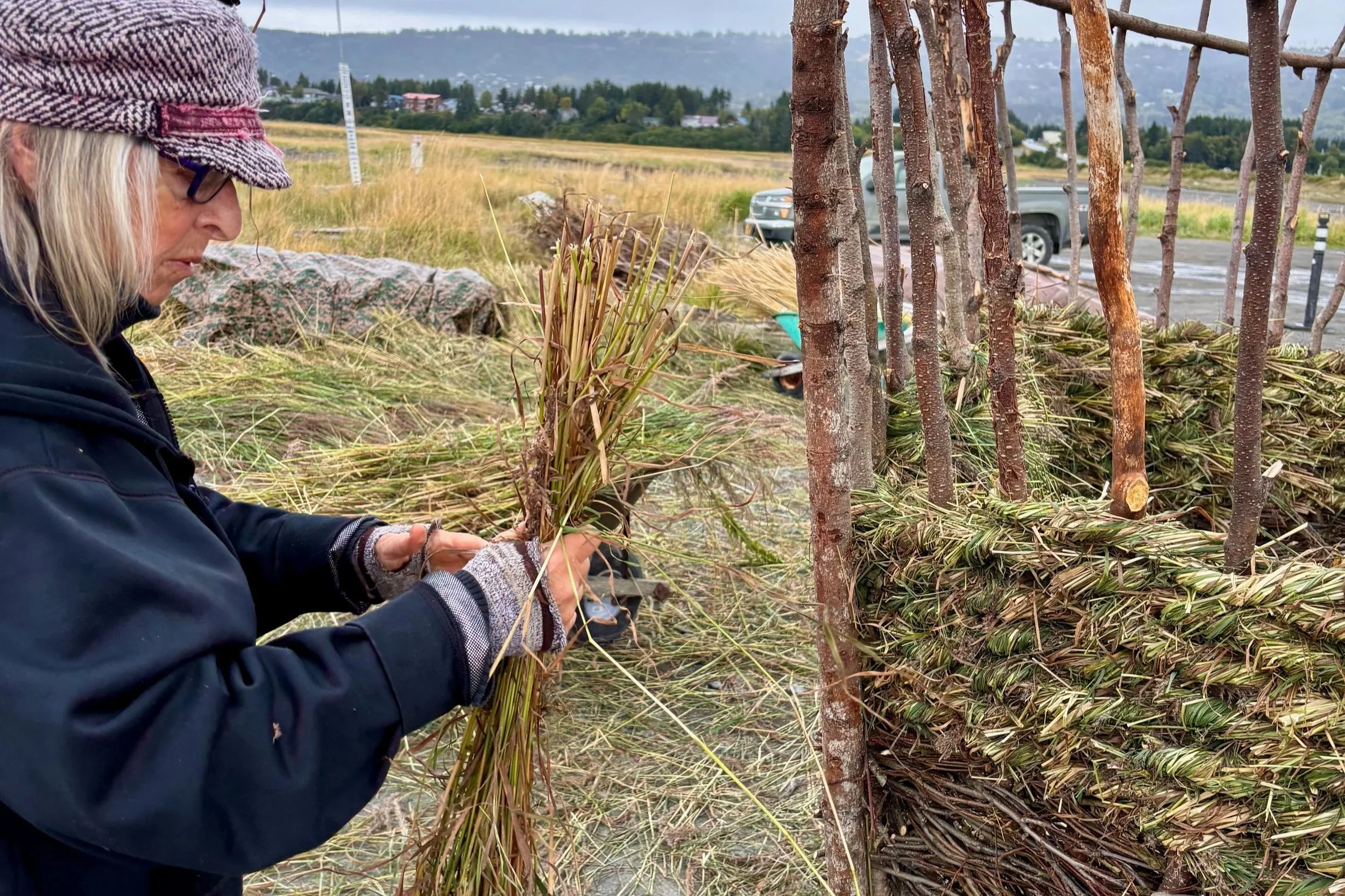
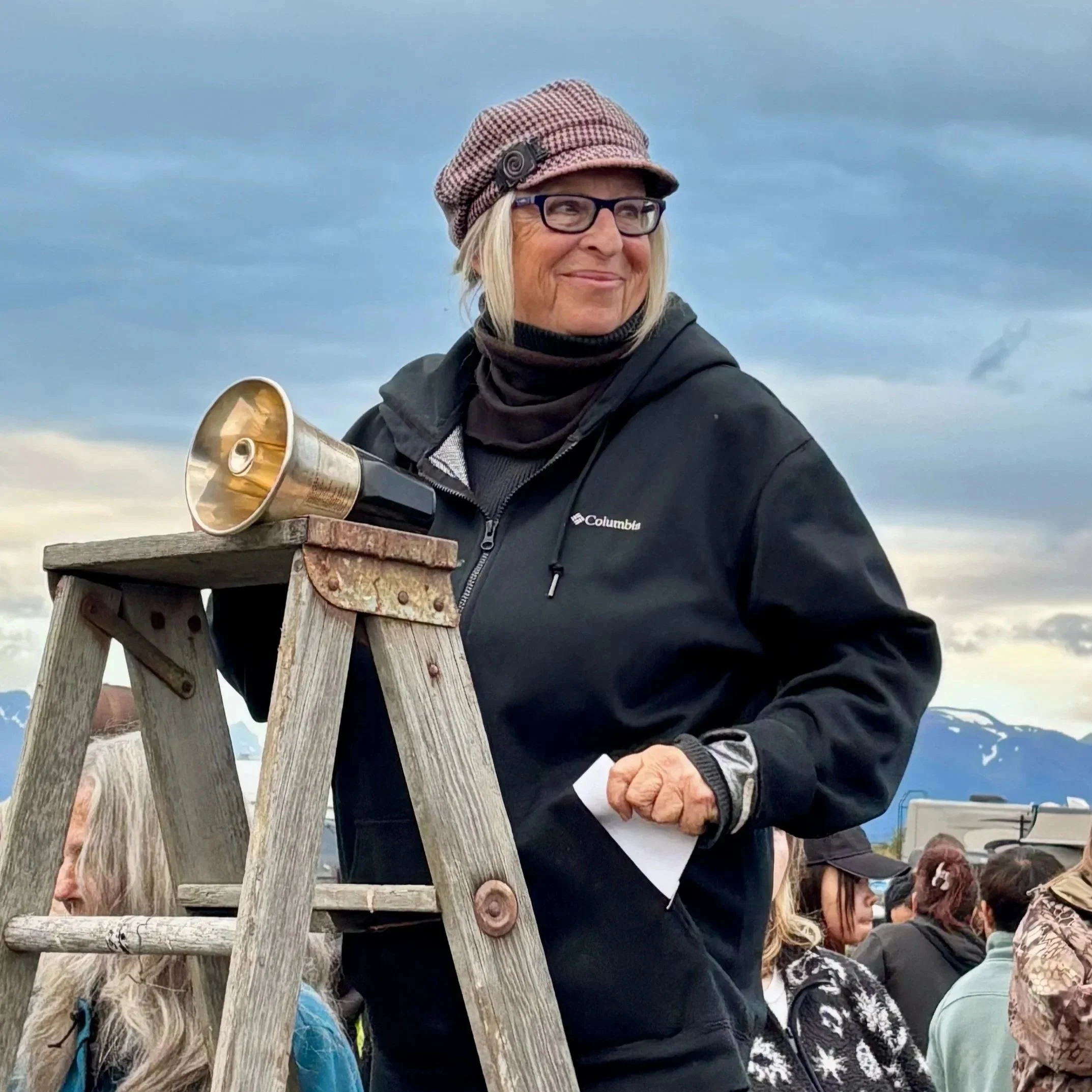
Mavis adding another layer to her Burnin Basket in Homer, Alaska 2025
Resources:
Mavis Muller, social media: https://www.instagram.com/mavisartalaska/
https://www.burningbasket.me
https://www.google.com/search?q=homer+burning+basket+video&oq=homer+burning+basket+
Photos by Tracy Nordstrom, unless otherwise noted